Ericsson 2025 Mobility Report

Ericsson Mobility Report 2025: 5G at the Crossroads of Innovation and Monetization
Every year we look forward to the Ericsson mobility report to provide insights and guidance as the to the direction of the market. This year has not let us down. The June 2025 edition of the Ericsson Mobility Report marks a significant turning point in the global telecommunications landscape. As 5G evolves from a mere aspiration to an established reality, the report underscores the approaches that telecoms providers or communication service providers (CSPs) are implementing as they transition from infrastructure setups to focusing on revenue generation, innovation, and expanding their ecosystems. Addressing issues from the data demands of India's users to the mid-band challenges faced in Europe, along with the monetization tactics utilized in North America, the report delivers a thorough insight into 5G's influence on digital economies.
Lets examine these under a number of topic headings.
5G Subscriptions Surge: A Global Snapshot
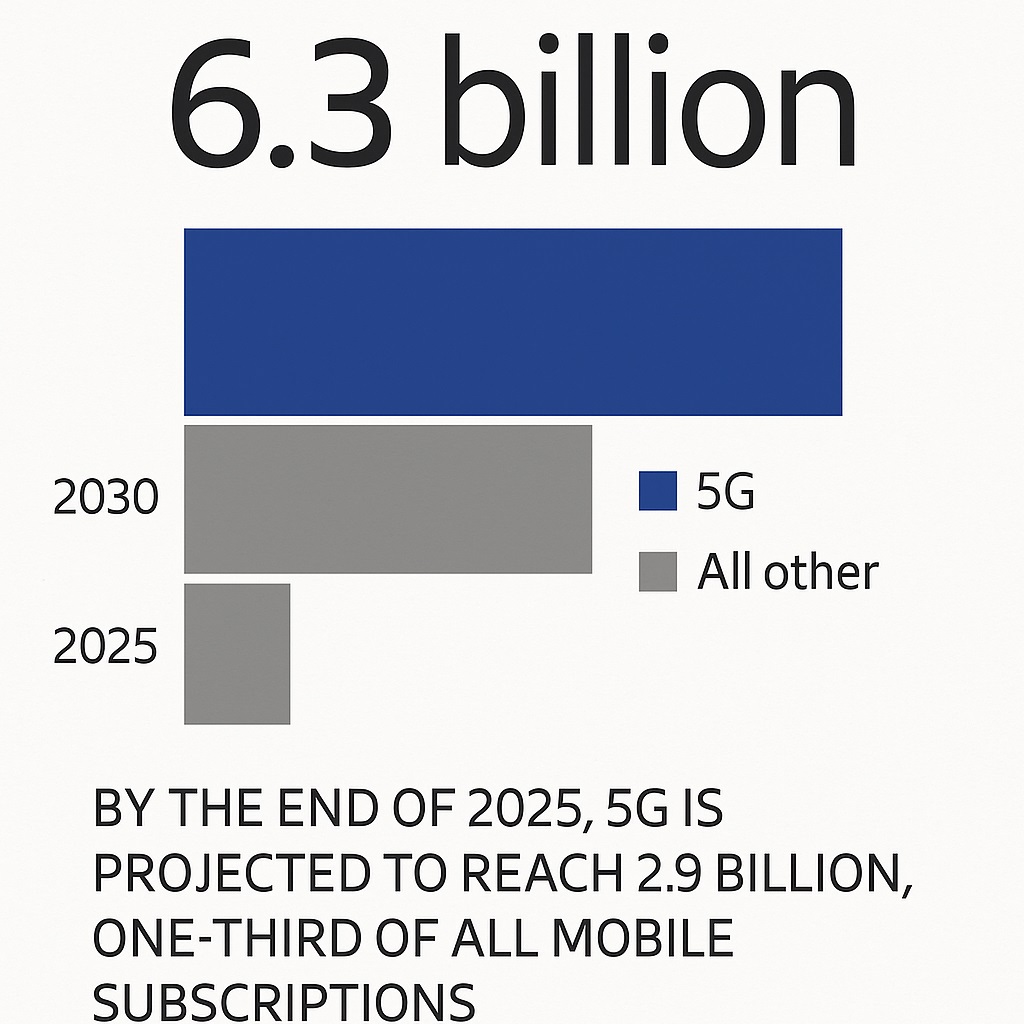
As expected, the adoption of 5G continues, and by the end of 2025, it is anticipated that worldwide 5G subscriptions will reach 2.9 billion, which will represent nearly one-third of all mobile subscriptions. This number is expected to more than double, rising to 6.3 billion by 2030. The growth is driven by the expansion of mid-band coverage, the emergence of Fixed Wireless Access (FWA), and the increasing availability of devices that support 5G.
By the end of 2024, 5G networks were already handling 35% of the global mobile data traffic, and this portion is projected to surpass 80% by 2030. 5G is facilitating new service models, immersive experiences, and enhanced connectivity for enterprises. This transition is both quantitative and qualitative.
Mid-Band Coverage: A Key to User Experience
While mid-band range typically operates between 1 GHz and 6 GHz, 3.5GHz is a good balance of speed and range and is currently the workhorse of 5G deployments. According to the 2025 report, mid-band is essential for delivering the full promise of 5G, enabling faster speeds, lower latency, and more reliable connections across urban and suburban environments.
In established markets, data shows that 97% of mid-band 5G users experienced page load times under 1.5 seconds, compared to 67% on low‑band 5G and 38% on 4G.
This shows that Mid-band coverage really is and will be one of the keys to the success of 5G rollout across the world.
North America: Monetizing Through Speed-Based FWA
North America continues to lead the world in 5G mid-band coverage, with over 90% of the population expected to be covered by the end of 2024. The region also enjoys the highest penetration of 5G subscriptions, which is anticipated to reach 91% by 2030. A notable trend is the increase in speed-based FWA (Fixed Wireless Access) plans, which now make up more than 51% of global FWA offerings, rising from 40% in 2024. These plans are similar to traditional cable and fiber broadband services, enabling communication service providers to profit from 5G through flexible pricing and bundled offerings. This model is gaining popularity in both urban centres and underserved regions, providing a practical alternative to wired broadband. We can see FWA plans to rise exponentially across the UK as the 5G rollout progresses as it takes away all of the costs and frustrations of traditional in the ground and over ground deployments of new fiber.
Europe: Catching Up in Mid-Band Rollout
The 5G development in Europe is characterized by both advancements and challenges. Although the region is projected to reach a remarkable 93% 5G subscription adoption by 2030, the highest in the world, it continues to fall short in mid-band rollouts, with coverage just surpassing 50%. This deficiency restricts the full capabilities of 5G Standalone (SA) networks, which are crucial for supporting complex use cases such as network slicing, Quality on Demand (QoD), and immersive content delivery. To close this gap, European telecommunications operators need to expedite mid-band deployments and invest in 5G Advanced technologies. Companies like the newly formed VodafoneThree will look to address some of these areas with massive financial commitments to the rollout of 5G across the UK.
UK Accelerates Deployment of 5G Standalone Networks
The UK is making significant progress in the implementation of 5G SA (Standalone) networks, with operators such as BT achieving coverage for 40% of the population. This transition to 5G SA represents more than just a technical enhancement; it serves as the backbone for network slicing, Quality on Demand (QoD), and the delivery of immersive content, all of which are crucial for opening up new revenue opportunities. Nonetheless, the advancement in the UK is moderated by a wider issue in Europe: mid-band 5G coverage is slightly over 50% across the region. This limitation hinders the complete realization of SA functionalities, particularly in providing reliable, high-speed, and low-latency experiences.
India Emerges as a Global 5G Powerhouse
While Europe lags behind, India remains at the forefront of global mobile data usage, with users averaging 32 GB monthly in 2024, a number projected to increase to 62 GB by 2030. Currently, there are 290 million 5G subscribers in India, and by 2030, this number is expected to rise to 980 million, which would account for 75% of its mobile user base.
What distinguishes India is its mid-band 5G coverage; at 95% of the population, it outpaces Europe and competes closely with North America.
This strong infrastructure is facilitating the swift adoption of Fixed Wireless Access (FWA), particularly in rural and semi-urban regions. Telecommunications providers like Reliance Jio are rapidly broadening their FWA services, with plans to connect 100 million households in the near future.
Middle East and GCC: Accelerating Toward Maturity
The Gulf Cooperation Council (GCC) nations are swiftly progressing in their 5G adoption, achieving a 45% penetration rate by the end of 2024 and a projected 90% by 2030. These countries are utilizing 5G technology to facilitate digital transformation in various sectors, including smart cities, logistics, and public safety. Fixed Wireless Access (FWA) is also gaining traction in the Middle East, especially in regions where wired infrastructure is scarce. The area is aligning with global trends by adopting speed-focused FWA models, contributing to the anticipated 350 million global FWA connections by 2030.
Fixed Wireless Access: A Growing Broadband Alternative
You can see that FWA (Fixed Wireless Access) is becoming a fundamental element in the monetization of 5G services around the world. More than 80% of global communications service providers are now providing FWA options, with an increasing trend towards speed-tiered plans. These services mimic the user experience of cable or fibre broadband, making them appealing to consumers and lucrative for providers. By the year 2030, FWA is projected to represent over 35% of new fixed broadband connections, totalling 350 million lines worldwide. The technology has a significant impact in areas with limited wired infrastructure, delivering quick deployment and expandable coverage. This will be very key to the rollout in developing nations, certainly where general development and access to other services is also an issue.
5G Standalone and Advanced: Unlocking New Use Cases
The report highlights the critical significance of 5G Standalone (SA) and 5G Advanced in facilitating unique services. Approximately 70 service providers have implemented SA networks, establishing a foundation for innovations such as live broadcast production, enterprise VPNs, and immersive gaming experiences. Providers are also investigating network APIs and programmable quality of service (QoS) to facilitate new applications in generative AI, extended reality (XR), and smart manufacturing.
These advancements are transforming communication service providers (CSPs) from mere connectivity facilitators to experience creators.
GenAI and Mobile Traffic: A New Paradigm
Though still in its infancy, Generative AI (GenAI) is starting to affect mobile data trends. Presently, GenAI traffic makes up a small portion of overall usage but shows a greater uplink ratio due to its interactive characteristics. As GenAI applications progress, from chatbots to creating multimodal content, they are anticipated to increase bandwidth requirements, particularly for uplink traffic. This change will necessitate that operators reevaluate their network capacity planning, quality of service models, and pricing strategies.
Glimpses of 6G: Dawn on the Horizon
Ericsson hints that the first trials for 6G might commence by 2030. Imagine networks that can perceive as they link up, automatically adjusting to your requirements, merging the boundaries between connectivity and awareness. This represents the upcoming frontier, and it's already subtly emerging on the horizon with countries like China beginning to test the possibilities.
The Turning Point
The Ericsson Mobility Report June 2025 outlines a clear roadmap for mobile connectivity: rapid 5G subscription growth, an increasing share of data carried over 5G, mid-band expansion, diversified broadband strategies via FWA, and a shift to standalone infrastructure.
In well-established markets, where there is a significant need for dependable, high-capacity connectivity, these insights offer practical advice. Operators, regulators, and enterprises must align strategy, policy, and investment to leverage this structural shift. The global story of 5G is one of transformation, and as Ericsson CTO Erik Ekudden puts it,
To fully realize the potential of 5G, it is essential to continue deploying 5G SA and to further build out mid-band sites
The decade ahead will not just be defined by 5G’s ubiquity, but by how effectively networks are optimized, monetized, and scaled to meet the demands of digital economies.
For more information about how your business can benefit from business mobile subscriptions, 5G FWA plans or another type of connectivity, send us a msg or give us a call.