UK Mobile Telecoms Top 20 Things You Should Know

We sell business mobile contracts to UK customers everyday, and we love talking about business contracts all day long, but its always nice when we speak with customers that know exactly what they want, so this guide is a way to help clients understand some important words and phrases related to mobile telecoms.
This is a list of the top 20 terms and phrases that you should have a basic understanding off when you are searching around for mobile contracts for your business. It will help you feel more confident in asking questions and hence secure better deals.
What is an MNO
MNO stands for Mobile Network Operator. A MNO is the company that owns and operates the Mobile Network infrastructure which includes all the towers, small cells, and physical infrastructure. In the UK, there are 4 MNO companies, namely EE, Vodafone, Three and O2. These 4 mobile network operators manage the entire spectrum of mobile communication for consumers and businesses in the UK.
What is an MVNO
An MVNO is a Mobile Virtual Network Operator. A mobile virtual network operator builds its own brand and business utilising the underlying network of one of the MNO (Mobile Network Operators) of which there are 4 in the UK. The MVNO never owns the telephone network, they simply purchase access or lease part of the MNO mobile network services. So when you see an offer from one of the many Mobile companies in the UK advertising their mobile contract deals, it will be using one of the main MNO networks. For example, TalkTalk mobile contracts are actually provided through the Vodafone network. If you want to know all the MVNO available in the UK, check out MVNO UK TOP LIST which shows you all the current available MVNO in the UK.
What is a Telephone Mast
A telephone mast is a large, typically triangular framework structure which connects into the MNO (Mobile Network Operators) network backbone. For the 3G and 4G network installs of the 1980's and 1990s, almost all of them were telephone tower mast installs. With the advent of 5G and its specific radio frequency characteristics, the traditional expensive tower Macrocell installations have been complimented with Rooftop 5G Aerial installations and also street level SmallCell installs.
What is a SIM Card
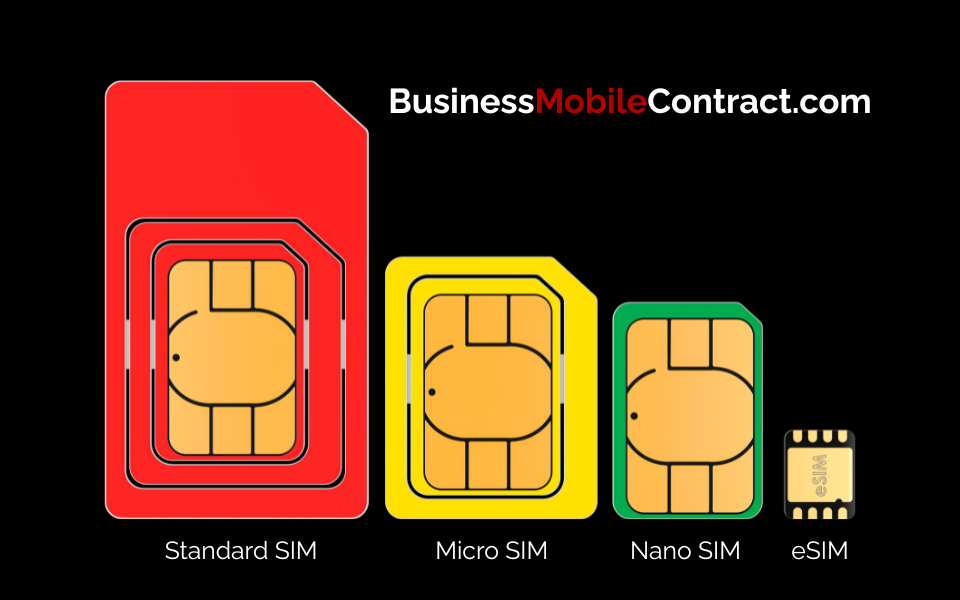
The word SIM is an abbreviation for Subscriber Identity Module. The SIM card is a small printed circuit board which is needed by any person or device which wants to connect to and authenticate onto a Mobile Network Operators core network. As SIM cards have evolved, their physical size has decreased to the current "nano sim" card which is the smallest of the SIM cards on the market. SIM cards are issued with associated mobile telephone numbers encoded into them. However, these numbers can be ported in and out of that SIM card and even in and out of MNO providers. A physical SIM can be moved from one mobile phone to another (as long as the mobile is not network locked to an MNO) and also from one mobile network operator to another network operator, and you take all information with you, as its stored on the physical SIM. The latest evolution of SIM cards is the eSIM.
What is eSIM
An eSIM is the latest innovation of the mobile network operators, and is being offered by some if not all operators since 2020. The earliest implementations of eSIM were utilised by Samsung for their smart watches and also Microsoft with their Surface tablets in 2016 /2017. The eSIM is a software-based SIM embedded into an irremovable eUICC (embedded universal integrated circuit card) which stores all the personal information allowing the authentication of the eSIM to the mobile network operators network. The eSIM chip is embedded by mobile phone manufacturers at the factory build stage. The advantage of eSIM is that it can store multiple profiles and be done remotely, providing deployment convenience, especially in IOT or M2M applications.
What is a Subscriber
A mobile carrier subscription is the contract between a Mobile Network Operator and the end user or "Subscriber" that is wanting network access. Any person or device that connects to the MNO network is a Subscriber. Mobile subscriptions are offered in a variety of configurations, ranging from SIM only to SIM and phone combined, 1 month duration to 36 month duration and sometimes more in IOT applications, and also with differing allocations of call time minutes, data allowance and roaming options.
What is a Mobile Carrier
A mobile carrier is another term for the MNO (Mobile Network Operator) or MVNO (Mobile Virtual Network Operator) that is providing the subscription service.
What is a Mobile Network
The mobile network refers to the infrastructure through which a mobile service is provided by a MNO or MVNO to a subscriber. The mobile network is everything from the telephony mast/macrocell or small cell to the fibre backbone network and core network over which the mobile calls and data are sent back and forth.
What is a Small Cell
A small cell is the terminology used to describe the antennae's that provide a 5G signal to 5G subscribers. Small cells are normally positioned close to the subscriber user, often at street level on lampposts or other street based furniture. Small cells typically have a short throw, meaning that they need to be deployed more densely to provide the 5G throughput that 5G subscribers expect.
There are essentially 3 types of small cells, namely femtocells, picocells, and microcells, which each respectively have a greater throw distance.
What is a Macro Cell
A macrocell is the term for a telephony mast or cell tower. This is the large tower structure that is ground mounted and geographically positioned to throw cellular mobile signal for distances that can be many hundreds of kilometres and service thousands of users simultaneously.
What is an Unlimited Data Plan
An unlimited data plan allows a subscriber to theoretically consume an unlimited amount of data within the billing period of the subscription contract between the Mobile Network Operator and the Subscriber. It is considered unlimited but most MNOs will enforce a "Fair Use Policy" so that users do not abuse the subscription service.
What is an IMSI number
An IMSI (International Mobile Subscriber Identity) number is a unique 15-digit code stored on a SIM card that identifies a mobile subscriber on GSM and UMTS networks. It consists of three parts: the Mobile Country Code (MCC), the Mobile Network Code (MNC), and the Mobile Subscription Identification Number (MSIN) which uniquely identifies the subscriber.
Business Mobile Contracts & Consumer Contracts Differences
A business mobile contract is designed to provide for the unique needs of the business user. For example some of the benefits that a business may expect in a business contract is different payment terms to those offered to consumers. A business mobile contract may also have flexible allowances custom created to provide them with a unique combination of call minutes, data allowances, IDD (International Dialling Destinations) and contract duration. From a management perspective the business mobile contract will also allow contract managers to deploy eSIMs, cancel eSIMS, provision additional allowances to users like data bundles or roaming destinations, as well as cancel SIMs in the field to prevent misuse when users leave.
What size are SIM Cards
SIM cards come in 3 sizes and a eSIM which is a chip built into phones by the manufacturer. The oldest SIM card size is the standard SIM, and they are rarely if ever now used in phones, but some routers still use them. Most phones now use the Nano SIM format because its physically the smallest and many phones can accommodate slots for 2 Nano SIMs inside the phone.
What is a Mobile Contract
A mobile contract is the legal agreement / subscription contract between the MNO / MVNO and the subscriber / business / user. The mobile contract stipulates the agreed duration of the contract, and the exact provision of call minutes / data allowance / roaming allowances / other features. Business customers should always pay attention to the mobile contracts they sign and look at the details. We often come across customers that are being hit with huge overage charges because their usage has fallen outside of their mobile contract.
What is 5G
5G is the fifth generation of mobile telecoms networks. Its the latest in the long line of evolution from 1G in the 1980s to 2G in the 1990s, 3G in the 2000s , 4G in the 2010s and 5G in the 2020s.
1G was basic mobile telephony, simple and only voice services.
2G expanded upon 1G and added a basic element of data services to the existing voice services.
3G added multimedia , video calling and the most basic level of internet access and streaming.
4G brought high speed internet access, mobile applications and gaming to the mobile experience.
5G represents the fastest in the line of succession with super fast internet access speeds, AR and VR experience capability, autonomous driving and smart applications.
What is Signal Strength
Signal strength is the power of the signal received by a mobile phone device or mobile router in IOT applications, from a cellular network. Signal strength is measured in decibels relative to 1 milliwatt dBm. A strong signal is a value closer to zero and a weak signal is a value further from zero. So a -20dBm value is far stronger than a -90dBm value. Stronger signal result in better call quality and fewer dropped calls. Strong signal strength is important in video conferencing and gaming applications.
Difference Between Business and Consumer Mobile Contract
A consumer contract offers a very limited level of flexibility, whereas the business contracts offer huge amounts of flexibility and control. So if you are a business, you definitely do not want to go the route of having lots of individual consumer contracts, as this will hugely disadvantage you. You want a single business contract where you can take advantage of pooled data allowances across your entire account, manage SIM activation and deactivation across your entire estate of SIM cards, and cancel and reissues SIMs when users leave or join the business. A business mobile contract is a far superior contract for any business with over 10 users to manage.
What are Pooled Data Allowances
In business contracts, aggregated, pooled or shared data is a way of sharing the total data allowance across all the SIM cards on the contract. In a pooled data situation, over users of data are covered by underusers of data, which means that its highly unlikely for you to pay data overage charges. Its a great feature of some business mobile contracts and really works well in managing business accounts.
IOT or Data SIM Card
IOT and Data SIM cards are essentially the same thing, but with different use cases.
Data SIM cards are perfect for scenarios in which a business needs an unlimited data allowance for mobile or laptop users, where the use case is primarily for an end user or device on the go.
IOT SIM cards are typically never sold as unlimited data allowance as they are coupled with security and networking features specific to IOT applications. An IOT SIM often has an associated static IP address, giving you the ability to apply additional security layers to the access of the IOT device. IOT SIMs are also typically multi network SIM cards, which means they can access more than one MNO network, sometimes all 4 UK MNO networks.
Summary
The top 20 above will give you a good grounding in telecoms terminology, and should help you finetune your business contract discussions. If you think there are others that should be on this list, let us know. If you want a team of experts to help with your next renewal or early renegotiations, get in touch.