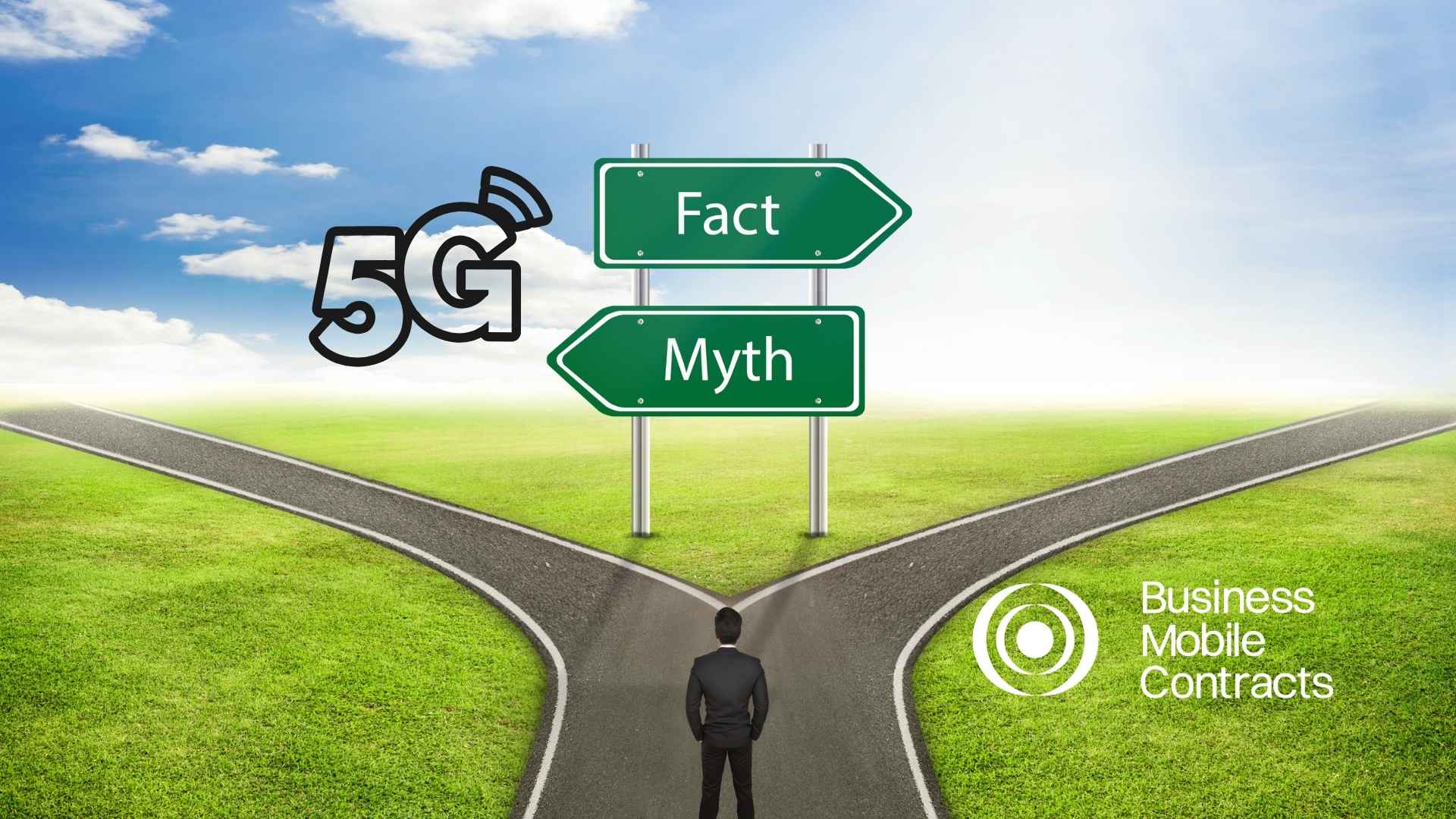
Debunking 5G Myths For The Enterprise

Prefer To Watch & Listen To Debunking 5G Myths?
The Era of 5G and the Ambiguity of Its Impact
Each technological advancement generates a mixture of enthusiasm and scepticism, and the advent of 5G technology is no exception. Discussions surrounding 5G within corporate boardrooms and IT departments are frequently influenced by misconceptions that either overstate its capabilities or undervalue its importance. The reality, however, resides between these extremes, and a nuanced understanding of this balance can enable forward-thinking organizations to gain a competitive advantage over their less adaptive counterparts.
For businesses in the United Kingdom undergoing digital transformation, the focus on 5G has extended beyond purely technical considerations. It now includes objectives such as improving operational efficiency, managing costs, and sustaining competitiveness in an environment where connectivity is a critical driver of productivity. Despite this, uncertainty remains, as a cloud of misunderstandings continues to obscure the tangible benefits that 5G technology aims to provide.
Myth One: 5G Technology Is Exclusively Intended for Large Corporations
A prevalent misunderstanding is that 5G technology is primarily designed for multinational corporations or large-scale manufacturers. Many small and medium-sized enterprises (SMEs) in the United Kingdom perceive the transition to 5G as overly complex or prohibitively expensive, thereby questioning its value. Contrary to this belief, 5G infrastructure is inherently scalable, enabling it to effectively accommodate a diverse range of organizations, from small local design studios to nationwide logistics companies.
This misconception largely stems from early promotional campaigns for 5G, which emphasized futuristic applications such as autonomous vehicles and smart city initiatives. While these concepts garnered significant attention, they inadvertently fostered the erroneous notion that 5G is only pertinent to large-scale operations. In reality, the most immediate benefits of 5G for businesses manifest in routine functions, including enhanced connectivity for remote employees, minimized latency in real-time data processing, and improved reliability in areas where 4G networks are insufficient.
For small enterprises utilizing cloud-based platforms or mobile payment systems, 5G facilitates more efficient collaboration and expedited transaction processing. Conversely, larger organizations can leverage 5G’s network flexibility and private network capabilities to support industrial automation and extensive Internet of Things (IoT) deployments. The critical determinant in both contexts is not the size of the enterprise but rather the strategic and effective application of the technology.
Myth Two: The Adoption of 5G Necessitates the Complete Replacement of Existing Systems
A prevalent misconception among business leaders is that the implementation of 5G technology requires a comprehensive overhaul of their current infrastructure. It is often assumed that existing Wi-Fi networks, 4G devices, and routers must be entirely replaced. However, this assumption is inaccurate.
5G should not be regarded as an entirely distinct technology; rather, it represents an enhancement that complements pre-existing connectivity solutions. In the majority of business environments within the United Kingdom, 5G and Wi-Fi are expected to function collaboratively rather than competitively. Each technology offers distinct advantages: Wi-Fi is particularly well-suited for localized indoor connectivity where considerations of control and cost-efficiency are paramount, whereas 5G provides superior wide-area mobility, heightened security, and consistent performance across multiple locations.
From a practical perspective, businesses can consider 5G as an additional layer of reliability. For instance, a logistics company might utilize Wi-Fi networks within warehouse facilities while depending on 5G to manage its vehicle fleet operations. Similarly, a retail organization may maintain in-store Wi-Fi for internal processes while leveraging 5G to facilitate contactless payment systems, digital signage, and remote customer data analytics. In this manner, the two technologies operate synergistically rather than in opposition.
Therefore, the deployment of 5G should be understood as an integrative process aimed at establishing a flexible digital ecosystem that capitalizes on the unique strengths of diverse network technologies. Organizations that embrace this integrative approach can effectively future-proof their operations without incurring unnecessary disruptions to their existing infrastructure.
Myth Three: The Immediate and Comprehensive Transformation Attributed to 5G
The term “revolution” is often invoked in discourse concerning 5G technology, with many stakeholders expecting that the adoption of 5G will instantaneously revolutionize their operations by providing unparalleled speed and automation capabilities. While 5G does enable such advancements, the transformation it engenders is not instantaneous.
In the United Kingdom, the deployment of 5G has been methodically planned and executed in a phased manner, with network coverage gradually extending across urban and suburban areas. For enterprises, this phased rollout means that the full spectrum of 5G benefits, particularly features such as ultra-low latency and network slicing, will emerge progressively as the requisite infrastructure matures. Nevertheless, 5G is already delivering significant advantages in its current stage of implementation.
Even at this nascent phase, 5G demonstrates notable performance enhancements compared to 4G. Organizations are experiencing improved video conferencing quality, faster data transfer rates, and more reliable connectivity in environments with high device density. For mobile professionals, these improvements translate into reduced downtime and more consistent service delivery. In industries such as construction and field services, 5G enables continuous access to cloud-based platforms and real-time communication across geographically dispersed sites.
Therefore, although the expectation of an immediate and sweeping revolution is unfounded, the incremental deployment of 5G is indeed transformative. Early adopters stand to benefit substantially as the technology continues to evolve and mature.
Myth Four: The Perceived High Cost of 5G Adoption for Businesses
A prevalent misconception is that the implementation of 5G technology necessitates substantial initial capital investment and incurs considerable ongoing costs. This perception is partly influenced by prior experiences with technological transitions, such as the shift from 3G to 4G, which required hardware upgrades and new contractual agreements—an experience familiar to many enterprises. However, the economic framework surrounding 5G deployment differs significantly.
In the United Kingdom, telecommunications providers offer tiered pricing structures and business-oriented plans that render 5G adoption more financially accessible than commonly assumed. For example, 5G SIM-only plans enable organizations to leverage the benefits of 5G connectivity without the need for expensive device replacements. Moreover, the improved efficiency of 5G networks often results in reduced bandwidth expenses over time, attributable to faster and more reliable connections that enhance support for cloud computing and Internet of Things (IoT) devices with fewer service interruptions.
Beyond mere connectivity enhancements, the principal value of 5G lies in its capacity to facilitate innovative business models. Private 5G networks, for instance, provide enterprises with dedicated bandwidth, thereby minimizing downtime and bolstering security measures. When evaluating productivity gains and operational efficiencies, the return on investment associated with 5G becomes increasingly evident.
For businesses in the UK seeking to curtail costs while enhancing performance, 5G should not be regarded as an extravagant expenditure but rather as a strategic asset that optimizes the utility of existing technological infrastructures.
Myth Five: The Security Risks of 5G Technology
The introduction of new technologies often generates concerns regarding security. Some organizations apprehend that the extensive connectivity enabled by 5G networks may exacerbate vulnerabilities, particularly given the unprecedented number of connected devices. Nevertheless, 5G technology has been developed with security as a core design principle, incorporating sophisticated encryption protocols and authentication mechanisms that render it considerably more secure than previous network generations.
In contrast to earlier networks, 5G utilizes enhanced identity verification processes and encrypted signalling, thereby significantly reducing the likelihood of unauthorized interception of communications. Furthermore, capabilities such as network slicing allow enterprises to create secure, private virtual networks within the public 5G infrastructure. This functionality is especially critical for sectors handling sensitive data, including finance, healthcare, and government.
Although no technological system is entirely impervious to threats and organizations must maintain rigorous cybersecurity measures, the architectural advancements of 5G represent a meaningful improvement in data protection. When effectively integrated with existing information technology frameworks, 5G can mitigate risks by alleviating network congestion and improving the management of data traffic.
The Wi-Fi and 5G Relationship: Competitors or Complementary Technologies?
A prevalent misconception regarding 5G technology is the assumption that it will entirely supplant Wi-Fi. This perspective, however, overlooks the operational realities of contemporary enterprises. Wi-Fi remains indispensable within office environments, warehouses, and campus settings due to its adaptability and cost-effectiveness, whereas 5G extends reliable connectivity beyond fixed locations.
In practice, leading organizations in the United Kingdom are adopting a dual-technology approach, integrating both Wi-Fi and 5G rather than selecting one exclusively. This integration facilitates seamless network transitions, ensuring uninterrupted service availability and optimal performance. For instance, a healthcare provider may employ Wi-Fi for indoor patient monitoring systems while relying on 5G for ambulance telemetry and remote medical consultations. Similarly, an event management company might utilize Wi-Fi to offer internet access to attendees, concurrently leveraging 5G for backend operations and crowd analytics.
The collaborative deployment of Wi-Fi and 5G thus creates a network ecosystem characterized by seamless, secure, and flexible connectivity, aligning effectively with the demands of the hybrid business environment.
Embracing the New Era of Business Mobility
Misconceptions regarding 5G frequently stem from perceiving it as a singular, disruptive event rather than as an evolving ecosystem. In reality, 5G transcends mere enhancements in speed or the introduction of novel devices; it facilitates a more intelligent and interconnected business paradigm. This technology fosters opportunities for automation, underpins the expanding Internet of Things (IoT), and enables organizations to operate with greater flexibility across diverse locations.
For businesses in the United Kingdom, the strategic emphasis should shift from questioning the adoption of 5G to determining how to effectively integrate it within their broader digital transformation initiatives. Organizations that succeed will be those that regard 5G not as an isolated investment but as the foundational element of a more agile and resilient network infrastructure.
Looking ahead, as private networks, edge computing, and IoT solutions become increasingly prevalent, 5G will function as the critical, albeit often invisible, connective framework uniting these technologies. By developing a comprehensive understanding of 5G’s capabilities and dispelling prevalent misconceptions, enterprises can confidently advance toward a future defined by enhanced connectivity.